By Liliana Peñaherrera & Alberto Vásquez
Movement Stories is a new series exploring how disability activists organise and work for change in different contexts. The aim is to look beyond success narratives and examine the politics behind their work: the strategies, alliances, tensions, and risks that shape it. We begin in Peru with a story of self-advocacy that helped reshape public narratives around intellectual disability and legal capacity.
✦ ✦ ✦
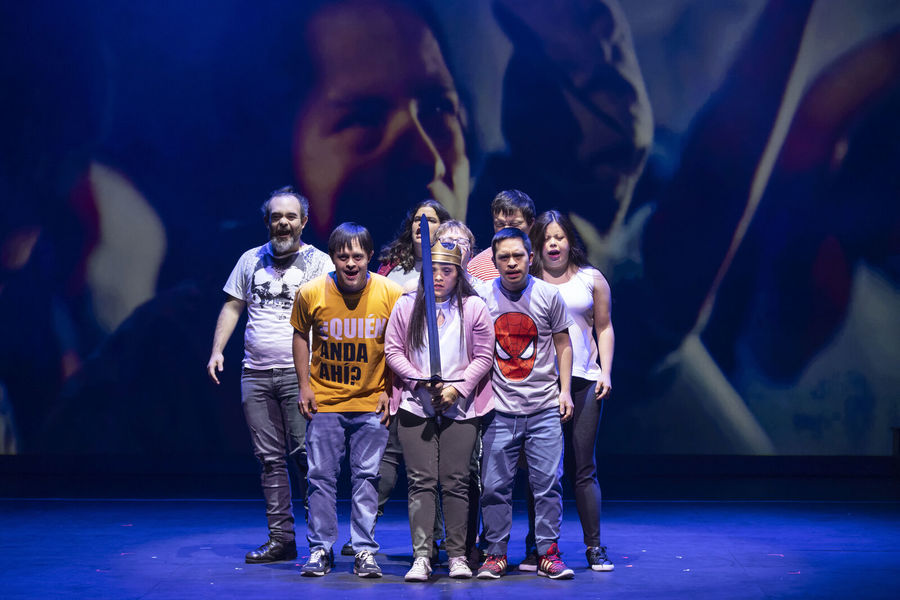
The theatre was full the night Hamlet performed in Lyon, France, in 2023.
For ninety minutes, the stage was filled with Hamlets and Ophelias. Eight actors. Monologues in dialogue with the present, lines that denounced exclusion, bursts of unexpected humour, and staging that broke the distance between the audience and the acting space. At the end, the audience was invited to come up and dance. The stage flooded with movement. For a moment, the lights no longer distinguished between actors and spectators.
Hamlet had premiered in Lima four years earlier, directed by Chela De Ferrari, and had since travelled far beyond Peru. The idea of staging the play with a cast of actors with Down syndrome emerged when Jaime Cruz, an usher at Teatro La Plaza in Lima, approached the director to express his desire to act.
What followed was a workshop that became a play—one that brought to the stage the experience of living in a world that often excludes people with intellectual disabilities. “To be or not to be” became a powerful prompt for the actors to voice the questions they carried but rarely dared to articulate. As De Ferrari puts it: “What does it mean to be?”
The production would go on to tour the world: Hong Kong, New York, London, Melbourne. Across more than twenty countries and over fifty cities.
After the performance, outside the theatre, the actors drank beers and danced reggaeton. They chatted with people who came up to greet them, to ask for photos, or to comment on the show. For them, it was just another night on tour, without their families, only the cast and the support team.
Before Everything Changed
Years earlier, in Lima, the scene had been different.
Karin Liza was sitting in front of an employment contract. After several interviews, she had been selected. She was about to begin working at a company in San Isidro. It would have been cause for celebration in any family. In hers—aware of how difficult it is for a young woman with Down syndrome to secure formal employment—even more so.
When the moment came to sign, the document slid across the desk and the pen changed hands. It was not she who signed. It was her mother.
Karin had been declared legally incapacitated. Legally, she could not sign her own contract. Her mother had to go to the bank to collect her salary and carry out formal procedures as her legal guardian. That is what the Civil Code established. More than a decade later, Karin would recall “That made me angry.”
In workshops, she had heard people talk about rights. About equality before the law. About autonomy. She had gone to Congress to speak about the right to work and to vote. But at that desk, with the contract in front of her, the law said something else.
“Mum, I have to sign it.” The answer was that she could not.
Later, Peru became one of the first countries to eliminate legal incapacitation on the basis of disability. Karin was part of that advocacy and among the first people with intellectual disabilities to obtain a court decision fully restoring her rights. She later spoke at a meeting in New York held by Open Society.
Years separate the contract Karin could not sign from the reform that restored her rights and the international theatre stages where Jaime and others performed. Time alone does not explain the shift. It was the result of organising, political education, committed parents, and a sustained demand for equity and justice. At the centre of it all was the Peruvian Down Syndrome Society (SPSD), where Karin and Jaime, like many others, trained as self-advocates.
Where It All Started
The SPSD was founded in the 1990s as a meeting place for families—mothers and fathers looking for information, support, and answers. For years, its work focused on accompanying families and advocating for access to education and health services for their children with Down syndrome. Over time, however, the conversation began to shift from what families could do for their children to what their children could do for themselves.
Towards the end of the 2000s, with the Convention on the Rights of Persons with Disabilities entering into force in Peru, the SPSD began to redefine its approach. Under the leadership of Liliana Peñaherrera, the organisation made a bet that was far from obvious at the time: to train young people with Down syndrome to advocate for their rights.
The first self-advocacy workshops involved a new kind of learning. When asked about their dreams or decisions, some replied, “I’ll ask my mum.” Not because they had no opinion, but because they were not used to expressing it in their own voice.
The programme built on decades of parental effort. Families had fought for inclusion, access, and recognition, often without institutional support. The workshops amplified voices that parents had been nurturing all along.
Through the workshops, the Convention stopped being a distant document and came to life as a tool. The right to vote, the right to inclusive education, the right to work, the right to decide. Legal language slowly translated into practical exercises: taking the floor, holding it, making demands, disagreeing, rebelling.
It was a deliberate organisational choice that transformed the very idea of representation. No longer substituting the voices of young people but accompanying them without replacing them. As Carla Mertz, a self-advocate from SPSD, says: “Independent, but not alone.”
When Things Began to Shift
The impact was not immediate, but it was cumulative.
Self-advocacy began as a simple everyday practice: organising schedules, taking part in decisions at home, using public transport without constant accompaniment, deciding to start working, opening a bank account. For some families, this meant significant changes that altered power dynamics.
Perhaps for the first time, young adults with Down syndrome felt their families were not the only safe place. That they could challenge their parents’ decisions without fear of retaliation because they had allies at the SPSD who could advocate for them. This realisation was both a revelation and a small revolution.
Participants in SPSD workshops began appearing in the media, joining cultural projects, intervening in debates, engaging in congressional hearings, and appearing in electoral lists. Sometimes, the change simply meant occupying spaces that had previously been reserved for representatives or families.
In many cases, these trajectories were not planned. The accumulation of public exposure opened unexpected opportunities. Some leadership roles emerged precisely because self-advocates were already there—visible and prepared.
Carla was among the first to take that learning beyond the SPSD. She participated in the self-advocacy workshops and soon began to occupy other spaces: serving as a member of her neighbourhood council, advocating for improvements in her community, participating in party youth groups, and later attempting to run for a local office.
It was therefore no coincidence that self-advocates began appearing on the front pages of major newspapers, demanding access to voting, education, work, independent living, and vaccination against Covid-19.
This growing presence began to alter public perception. People with Down syndrome were no longer seen simply as beneficiaries or subjects of inspiring stories, but as interlocutors with voices of their own.
Claiming Citizenship
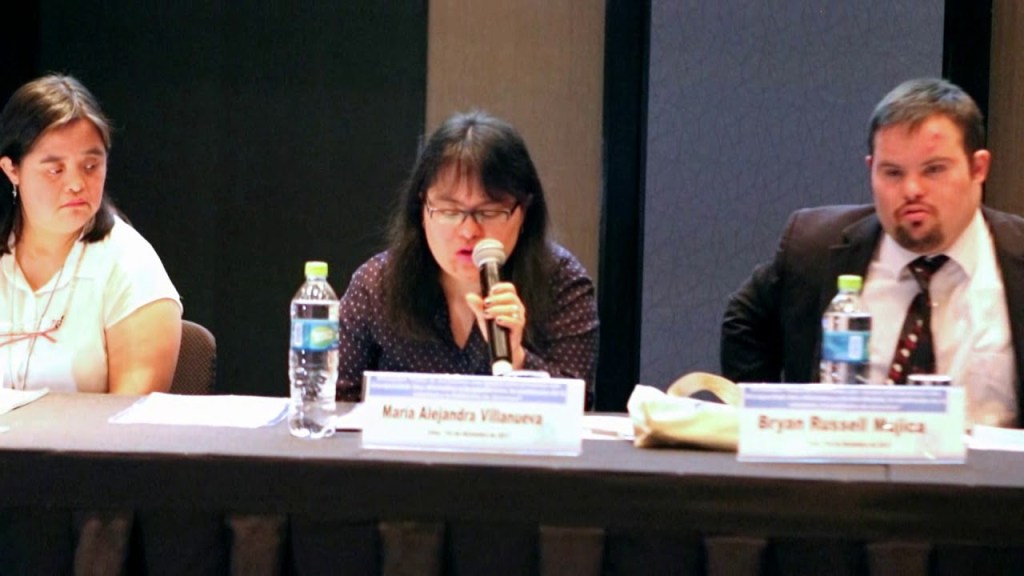
When María Alejandra Villanueva went to renew her National Identity Document in 2010, she discovered that she had been removed from the electoral register. The number of her polling station had disappeared. She could not vote and, therefore, could not carry out banking or notarial procedures either. Without prior explanation, her citizenship had been suspended because she had an intellectual disability.
It was not an isolated case or an administrative error. More than twenty-three thousand people with intellectual and psychosocial disabilities had been excluded under the same mechanism. Rather than going through individual legal proceedings to declare someone legally incapacitated, authorities had simply removed them from the electoral register. In a country with compulsory voting, that decision carried multiple restrictions on civil life.
María Alejandra chose not to accept the measure. With support from her mother and the SPSD, she reported it to the Ombudsperson’s Office and to Human Rights Watch. She met with government officials, spoke to the media, and eventually presented her case at the United Nations in New York.
The accumulated pressure eventually pushed the authorities to act. The National Registry of Identification restored the right to vote to María Alejandra and to thousands of others. Years later, the reform eliminating legal incapacitation on the basis of disability ensured that such exclusions could no longer occur.
María Alejandra’s struggle opened a door. Bryan Russell Mujica decided to walk through it and go further.
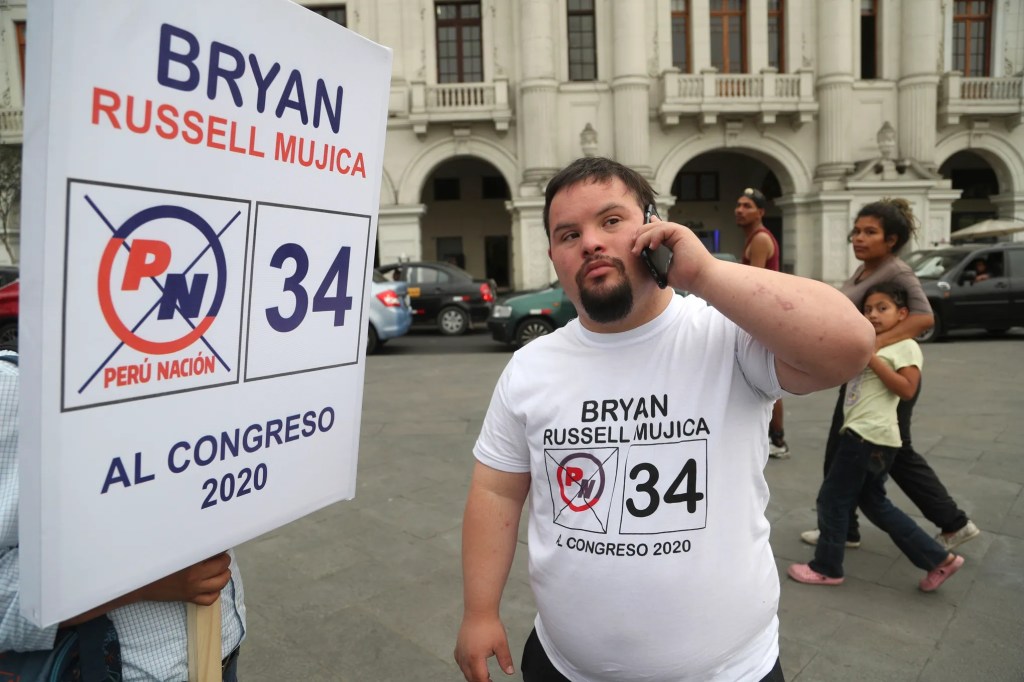
In 2019, Bryan, who had also been part of the SPSD self-advocacy programme, decided to run for Congress. He campaigned, gave interviews, and presented proposals on inclusive education and employment. He appeared in public debates where, until then, the political representation of people with Down syndrome had been unthinkable.
Years earlier, Bryan had become the first person with Down syndrome to complete a university degree in Peru. He had to insist that his communications degree be formally recognised. The struggle over his diploma was, in a sense, a prelude to the electoral contest.
For weeks, his face appeared on posters and news broadcasts. He received nearly 14,000 votes. To put that number in perspective: the current president of Peru entered Congress with less than half that number. Beyond the electoral result, the campaign revealed another possible image of citizenship.
Between María Alejandra reclaiming her right to vote, Karin demanding her right to decide, Carla occupying spaces in local politics, Bryan running for Congress, and the actors of Hamlet bringing their experiences to international stages, there is more than a generational coincidence. Behind it are committed families and years of work in training, accompaniment, and public visibility for people with Down syndrome—grounded in leadership that demanded both families and the state respect the voices of people with intellectual disabilities. It is the result of years of workshops, debates, tensions, and organisational decisions that eventually became visible. And, as often happens with profound change, it was not always smooth sailing.
Letting Go
Self-advocacy is an immense change for families, the community, society as a whole, and certainly for people with intellectual disabilities. Self-advocacy comes with fears, tears, eagerness, courage, love, confidence, hope.
“I used to want my daughter to die with me,” one mother admits—not in a dramatic tone, but as an expression of the fear she felt. Fear that the world would not be ready. “Now I talk with her about what it will be like when I am no longer by her side. We talk about it without fear. For me, that is almost a miracle.”
Each step towards independence meant a new conversation at the family table. Some issues were especially difficult to address: the desire to live alone, to decide about one’s sexual and emotional life, to go out without asking permission, to sleep in one’s own room, to marry, to have children. “It’s not like before, but it’s not thaaaat different either,” one of the self-advocates confesses.
For many parents, however, it meant revisiting years of intense protection. Letting go was not easy. It meant allowing their children to make their own decisions, to go out alone, to date, to make mistakes. To challenge family decisions. To say: “I’m grown up now.”
Some families could not accept it. “Since he started attending these workshops, my son no longer obeys me,” one father said. “The workshops are over.”
Change Within
The change was not automatic within the SPSD either.
The shift from a family-centred model to one that promoted the direct leadership of young people with Down syndrome meant redefining roles. Who speaks at a public meeting? Who makes strategic decisions? Where does support end and interference begin?
Moreover, visible success generated new expectations. Participating in hearings, travelling, giving interviews or taking on public spokesperson roles brought pressure. These spaces opened opportunities and, at the same time, tensions: competition to occupy them, but also the desire to avoid exposure that not all self-advocates were willing to assume.
Over time, other fissures appeared: changes in the board, differences over the organisation’s direction, loss of funding, and accumulated exhaustion. Some voices argue that the organisation lost part of its momentum. Others believe the context changed and priorities dispersed.
The pandemic accelerated those tensions. In-person workshops were suspended. The collective dynamic fragmented. For many young people, public participation became limited to screens. Many families retreated into more intensive care dynamics. What had taken years to build—trust, autonomy, presence—was suddenly put on hold.
However, the process did not come to a complete halt. Amid the uncertainty, new forms of meeting began to be tested: structured virtual meetings, hybrid spaces, attempts to reactivate the self-advocates’ group, and conversations about how to update the agenda. The challenge now is how to sustain self-advocacy in a more unstable social and political context, with fewer resources, greater public insecurity, and with local, regional, and national governments that have lost legitimacy.
Behind the Stage
This process of change was not an exceptional moment, but the result of a specific configuration of actors, decisions, and political opportunities.
First, the Convention on the Rights of Persons with Disabilities was a turning point. It introduced a common language that made it possible to transform experiences of exclusion into demands for equality before the law and full recognition. This framework gave coherence to the actions that followed.
The Convention also facilitated access to new sources of international funding aimed at its implementation, which made it possible to sustain initiatives such as the self-advocacy programme.
Second, there was a clear organisational decision. The SPSD, then led by Liliana Peñaherrera, chose to invest time and resources in a self-advocacy programme that had not previously been a priority. This meant reconfiguring their work plan and internal balances of representation.
That shift, however, did not begin from scratch. In the 1950s, a group of families with economic and political resources, driven by the question “what will become of my children when I am no longer here?”, opened sheltered workshops and purchased four adjacent apartments for independent living skills. Though the apartments were never put into operation, the vision took hold. The children of these families used public transport, dated, organised their leisure time. Most were men: Coqui Barandiarán, Alfredo Arispe, Rafael de la Fuente, Diego Elías. Two became SPSD leaders; one served as a board member.
Third, there was a consistent methodology. The workshops were not limited to motivational dynamics or the repetition of concepts. They focused on translating rights into practical situations and carefully preparing public interventions. Before a hearing or an interview, presentations were rehearsed and questions anticipated.
Fourth, alliances were built with a wide range of actors. The Ombudsperson’s Office facilitated institutional channels; law firms supported the preparation of legal actions; local NGOs opened spaces for joint advocacy; international organisations helped bring visibility to the cases; and academic networks contributed technical arguments. This coordination allowed individual experiences to move beyond the family sphere and become matters of public concern.
This context also had names. The opening of spaces in Congress by figures such as Javier Diez Canseco allowed these demands to find interlocutors willing to listen and translate them into legislative initiatives. The reforms that eliminated legal incapacitation were not solely the result of SPSD’s work, but the self-advocates were ready to intervene in the process.
These factors allowed the self-advocacy programme to function and produce visible effects, even though the number of participants remained relatively small: between 70 and 80 people over the years, around 18 of them participating regularly.
For those seeking to promote similar processes, this experience shows that impact does not depend on the number of participants, but on sustained work, strategic alliances, and a vision capable of reading and making use of the political context.
In the First Person
Karin still remembers the contract from 13 years ago clearly. Her mother signing it for her.
Today the scene is different. Karin works and financially supports her family. When she talks about what changed, she does not begin with the legal reform. She talks about being able to decide. About managing her own money. About having a say at home without her words being left hanging.
“It wasn’t fair,” she says about that contract. Behind that sentence are years of workshops, legal debates, reforms, and tensions that made it possible for that scene not to repeat itself.
Jaime also returns to the beginning when he speaks about his path: the moment he shared the idea that would give rise to Hamlet. “I was the seed,” he says. Chela de Ferrari listened, and from that moment the stage also became a space to talk about rights.
For Jaime and the other actors, Shakespeare’s existential question became deeply personal: “We are afraid of what may come after death. We prefer to suffer rather than to die. Or else explain to me: why do we endure the abuses of the world, people’s insults, the sorrows of love, the delay of our rights? Why?… Our life is a project: To be or not to be?”
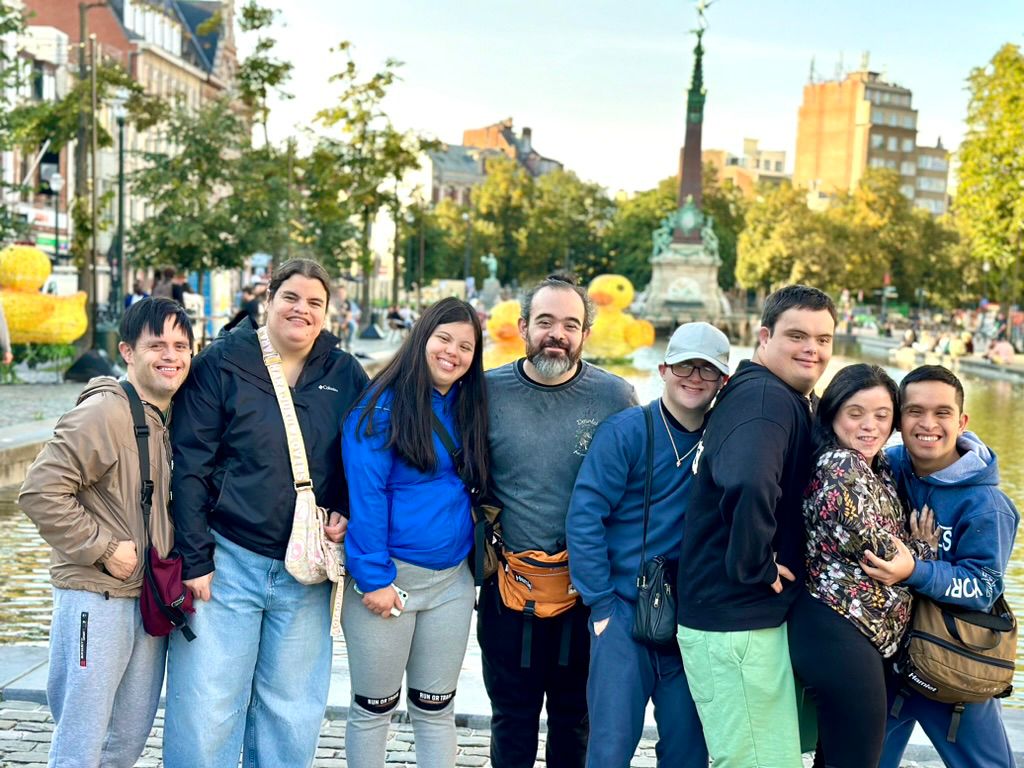
Among those stepping onto the stage in Lyon were also Octavio Bernaza and Ximena Rodríguez, actors in Hamlet and a couple offstage. They are preparing to get married at the end of 2026. They will be the first couple with Down syndrome to do so in Peru. When they decided to marry, they did so with support, yes—but also with the conviction that they want and can live together without someone else deciding their path.
“We decide what we want,” says Ximena, a self-advocate with the SPSD. “How we manage it, we do with support. The leadership is ours.”
And this time, the story is theirs to tell.
Feature image: Actors from Hamlet perform during an international tour of the production. Photo: Jess Shurte.
 Mad Thinking