Can we reform systems that harm, control, and oppress people or do we need to imagine and build a different world?
For centuries, people resisting slavery, colonialism, prisons, psychiatry, institutionalisation, state violence, and other systems of punishment and control have asked this question. Today, it remains as urgent as ever.
Over the past few weeks, we explored this question and more through Building a New World: An Invitation to Abolitionist Thinking, a three-part webinar series organised by Mad Thinking. Across the series, we were joined by Stephanie Davis, Priya Raghavan, Stefanie Lyn Kaufman-Mthimkhulu, Kokila Annamalai, Ari Lutzker, and Chelsea Jackson. Together, they explored abolition as a political tradition, a framework for understanding interconnected systems of harm, and a practical commitment to building alternatives rooted in care, solidarity, and collective liberation.
This piece brings together some of the insights and lessons that emerged across the three discussions. Like the webinar series as a whole, it reflects on crucial questions: What are we trying to abolish? Why abolition rather than reform? What are we trying to build? And how do we get there?
You can watch the recordings of the three webinars here:
- Session One: What is abolition and why does it matter?
- Session Two: Abolition across struggles: Prisons, police, and beyond
- Session Three: Building the world we want: Abolition in practice
What is abolition?
Coming from and embedded in different movements and regions, our speakers discussed a range of harmful systems—prisons, policing, death penalty, psychiatry, institutionalisation, capitalism, border regimes. On first look, these systems and practices look very different from each other: the people affected by them, their relevance to different parts of the world, the movements concerned with them, and the tools used to challenge them.
Our speakers explained that there is an underlying logic behind these systems, and other social structures and relations—punitive and carceral methods are necessary to manage and control populations. In other words, there is an assumption that to maintain social order, states and those in power need to discipline ‘deviant’ communities by punishing them, locking them away, and in some cases, killing them. Abolition is the task of challenging this foundational assumption and building a society that does not rely on it.
Punitive logic and practices permeate many institutions—surveillance and racism within healthcare and education, discipline and punishment-based welfare/benefits systems, exploitation inherent to capitalism and colonialism.
Stefanie Lyn Kaufman-Mthimkhulu outlined in depth what abolition means in relation to psychiatry—first, abolition of the actual institutions which function with the same carcerality as prisons; second, the psychiatric discipline which upholds these institutions; third, the language and discourse of psychiatry which permeate and are weaponised by society and culture; and finally, colonial order upon which psychiatry is built. Psychiatric abolition is not just closing down institutions. It means “dismantling the systems of knowledge, power, and practice that transform wounds of colonial and racial capitalist violence into individual pathology”.
A moving and striking theme across discussions was how social movements and people internalise punitive logics to resolve conflicts. Ari Lutzker named it “the punitivism in our blood”, which shape our interpersonal relationships, communities, and activist collectives. For example, when harm occurs within movements, our first instinct is often to shame, isolate, or expel the individual perpetrator, rather than asking what conditions enabled the harm, how accountability can be fostered, and what is needed to prevent it from happening again. There is a need to acknowledge this tendency and build alternative ways to resolve harm and conflict.

Why abolition rather than reform?
Mad and disabled people have long known that a different uniform, degree, and language doesn’t change the system itself—doctors instead of police, “for your own good”, soft restraints instead of handcuffs. We can paint the building, but as long as the foundation stays untouched, we will not be liberated.
The same is true for all other systems we have identified as harmful, whether it is policing or capitalism. Reforming these systems, i.e., tweaking them and making minor changes, do not change their structure. Furthermore, by making the system more palatable without challenging its underlying logic can work to further establish their dominance. Dismantling the system, rather than reforming it, becomes the only option for liberation.
Abolitionist activists do recognise the urgent need to reduce suffering and harm. They provide a framework to guide their immediate actions—non-reformist reform. This set of practices or strategies are aimed at minimising harm to individuals and communities in the short term while at the same time shrinking the system in the long term.
A practical tool to differentiate non-reformist reform from reformist reform is to ask “will this expand the system we’re trying to dismantle? Will we have to undo this later?” Priya Raghavan illustrated this with an example: the campaign for the use of body cameras by police can seem like a push for transparency and accountability. However, it increases police budgets which expands the policing system. A non-reformist reform would be a push for reallocating police funds to community services, an incremental step which shrinks the dominance of policing systems.
What are we trying to build?
All of our speakers, in diverse ways, reminded us that building alternatives based on collective care, interdependence, and liberation is a critical aspect of abolition. They gave examples from their own work and experiences of building such alternatives.
Mutual support is a critical organising principle for abolitionist alternatives. Whether it is peer support instead of coercive mental healthcare, mutual aid instead of charity, or YoNoFui’s concept of Segundeo (a practice of reciprocal accompaniment and support), the aim is to build systems that centre interdependence and community.
For disabled and Mad communities, the concept of interdependence is not new. For decades they have relied on mutual support in the face of state neglect—from survivor networks to centres for independent living. They have also experienced and challenged violence masquerading as care and have embraced an ethos of collective care. Their traditions, understandings, and activism already incorporate many of elements of abolitionist alternatives.
Non-punitive justice is another pillar of practicing abolition. Harm and conflict are inevitable parts of life. Chelsea Jackson pointed to transformative justice approach as a way to deal with such situations. Transformative justice does not rely on naming a single person as a perpetrator of harm and punishing them. Rather, it asks deeper questions about the conditions that enable harm and perpetuate cycles of violence. It then seeks to transform those underlying conditions while holding persons who harmed accountable.
Ari also emphasised the need for approaching conflicts without creating binaries of good vs bad people. Additionally, he stressed the importance of building a plurality of justices, i.e., alternative justices (including Mad justice, disability justice, racial justice, environmental justice, ancestral justice) and contextualising the practice of resolving harm and conflict. Non-punitive justices require a commitment to accountability, an ethos of collective responsibility for the spaces we occupy, and the practical skills needed to de-escalate, intervene, and respond to harm, abuse, and violence.

How do we get there?
Abolition seems like an impossible task, given the centrality of punitive logics in our lives. Our speakers described in depth what abolitionist activism looks like for them.
Political education: Stefanie reminded us that individual experience does not automatically translate into systemic understandings and activist action. A process of political education and connections with resistance struggles is needed for mass mobilisation. Kokila Annamalai used a striking example of how they do political education within their movement. They start by asking “When was the first time you were punished and what was its impact?” The ensuing discussions go on to connect these lived experiences to larger analytical and systemic issues such capitalism and imperialism.
Shifting narratives: Carceral systems rely on othering and demonising the people most impacted by them—whether it is dehumanising prisoners, framing disabled people as less-than-human, or Mad people as incapable. A significant part of the abolitionist activism is to shift these narratives. It is important to relay the message that abolition is not just of concern to a few affected communities, but rather an issue of the masses because all of our lives are shaped by practices of policing, punishment, surveillance, and state and capitalist violence. The process and practice of political and societal education is part of a larger strategy of building collective power within the masses in order to agitate for change.
Imagination, creativity and experimentation: In our work as organisers and activists, we are often confronted with the question “What do we have now, and how can we make it better?” Mariame Kaba, a Black feminist abolitionist, asks us to start with a different question “What can we imagine for ourselves and the world?”. Whether due to state repression, funding and material pressures, or simply the ubiquity of punitive and violent systems, it is hard to imagine what an abolitionist world would look like. Creative methods of resistance, experimentation with ideas and tools through art and writing, and radical imagination are part of abolitionist organising.
Healing our movements: It is no secret that conflicts and harm weaken or even tear apart movements. Stephanie Davis reminded us that organising is often fractious and fragile and there is a need to build skills and resources which resolve conflict and harm by addressing their root causes. All of our speakers emphasised the need for activists and movements to abolish the “cop in our heads” and practice transformative justice and alternative justice as a way to build stronger movements as well as a critical aspect of doing abolitionist activism.
Connecting issues and connecting struggles: Abolition’s recognition that similar logics underlie many systems makes it inevitable that the struggles to change these systems need to be connected. Solidarity between movements is an essential part. This is not always easy. Even within abolitionists, there is lack of knowledge about each other’s struggles and biases. Stefanie described how Black movements for prison abolition often exclude Mad folks, some even going so far to argue that psychiatric care should replace prisons. On the other hand, Mad movements do not always embrace anti-racism in their work and make solidarities with Black movements in the US difficult or impossible. Exchanging knowledge and working in solidarity with each other is the only way to build the new world of our imaginations.
Closing
The ethos and practice of abolition are already present in many parts of the Mad and disability movements, whether we call it that or not. We refuse to compromise on demands to end institutionalisation in any form. We continue to build peer support and collective care. And we have multiple examples of independent living and community-based alternatives.
Whether it is climate change, or war, or late capitalism, Mad and disabled people will face extreme levels of violence as the world collapses around us. We know this and have always known this. We know too that we cannot simply rely on state power to protect us. There is a wealth of knowledge from abolitionist movements spanning centuries that we can benefit from, add to, and carry forward.
Resources
Throughout the discussions, our speakers referred to several organisations and abolitionist thinkers and activists. The activism and scholarship of Angela Y Davis, Mariame Kaba, Ruth Wilson Gilmore, Harriet Tubman, and W.E.B. Du Bois as well as many other Black feminist and civil rights activists are critical to understanding abolition. Texts that are a useful starting point include “Are Prisons Obsolete?” (Angela Y Davis); “We Do This ‘Til We Free Us: Abolitionist Organizing and Transformative Justice” (Mariame Kaba); “Brick By Brick: How We Build A World Without Prisons” (Cradle Community).
The organisation, Critical Resistance, has created a practical set of tools to understand non-reformist reform. Healing Justice London has a dedicated Movement Medicine programme designed to transform and heal social movements. EndSARS movement in Nigeria was brought up as an example of abolitionist campaign. The Community Justice Exchange and the Dalit Panthers were mentioned as examples of knowledge exchange and trans-national solidarity, respectively.
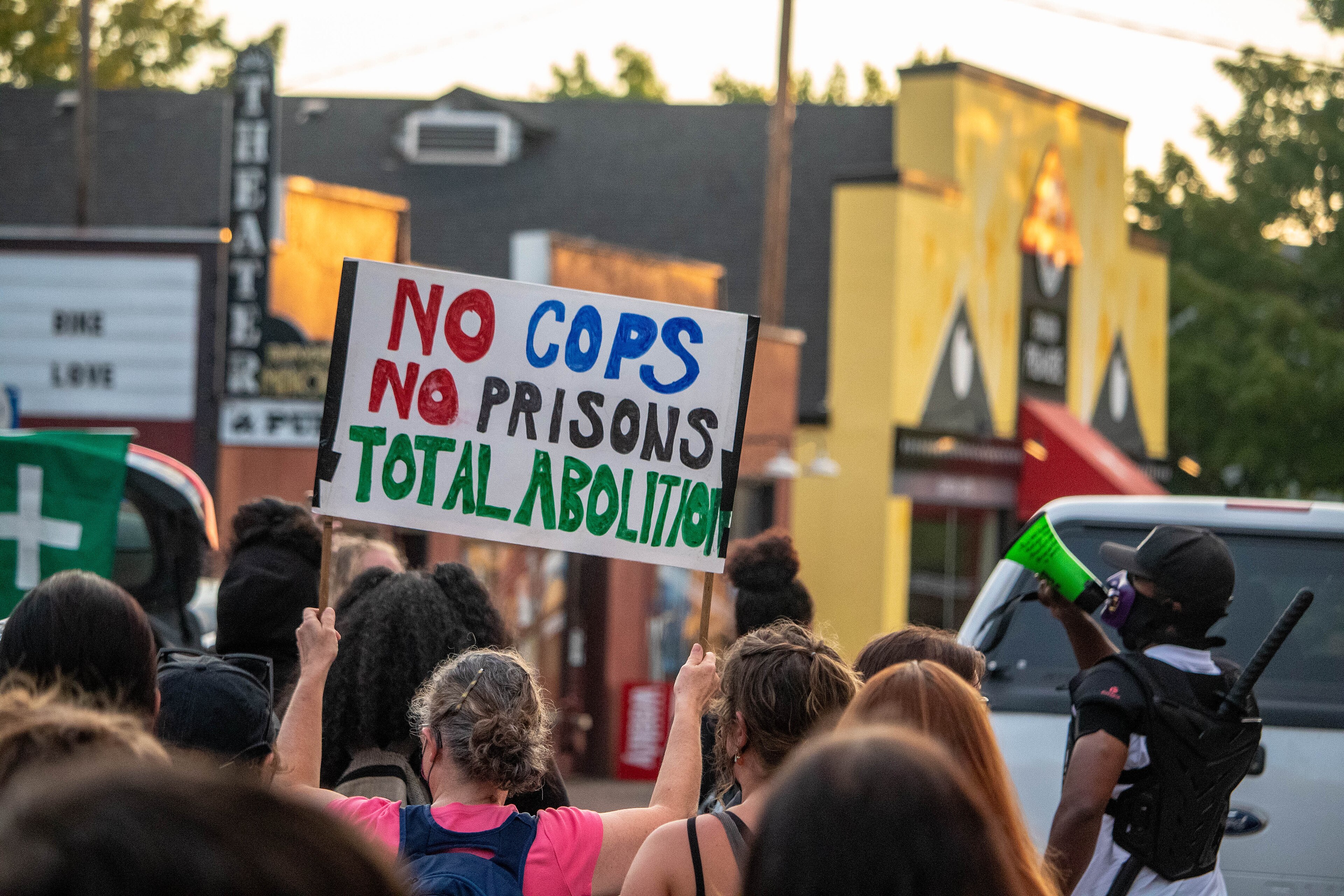
Featured Image: Protestors march at a Black Lives Matter protest in Oregon, USA. August 2020. Photo credit: David Geitgey Sierralupe via Wikimedia Commons.